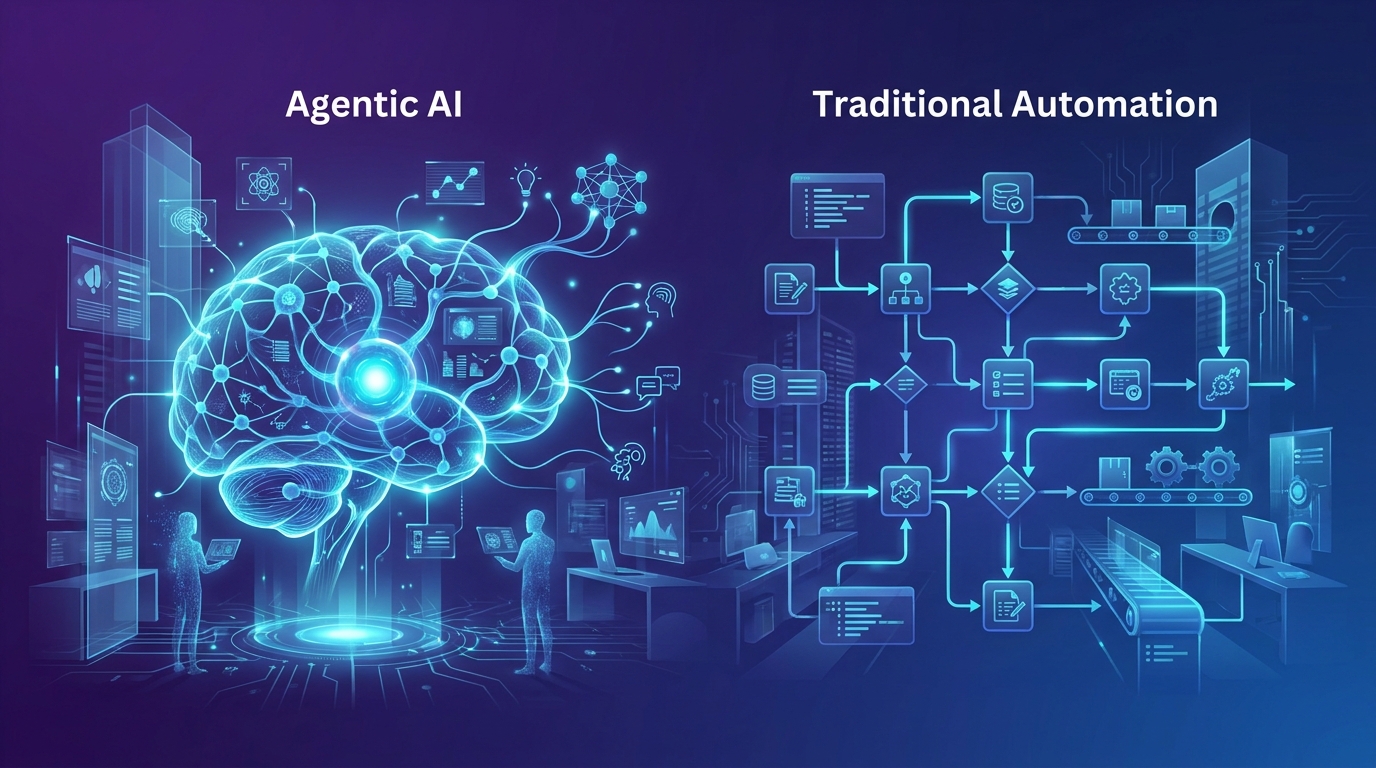
Agentic AI vs Traditional Automation: Which Should Your Business Choose?
Author: Agent Agency Team
Published date: August 12, 2026
Reading time: 7 minutes
Location / Area Served: Cape Town, South Africa (Serving South Africa & Global)
1. The Automation Illusion: Why Your Bots Keep Breaking
Traditional automation is like classical music—sheet music dictates every single note. AI agents are like jazz—they improvise, feel the room, and adapt on the fly. Both are brilliant. But if you hire a jazz band to play a classical symphony, you get expensive noise.
Right now, the enterprise world is generating a lot of noise.
As of August 2026, 80% of enterprises report having at least one production application embedded with an AI agent. That sounds like a massive victory for AI, until you look at the graveyard: 88% of enterprise AI agent proofs-of-concept (POCs) fail to reach full production.
Why? Because tech leaders are confusing the tools. They are forcing rigid traditional automation to solve dynamic, messy human problems. Or, conversely, they are throwing unconstrained, non-deterministic AI agents at strict compliance tasks that demand 100% predictability.
You don't need more AI hype. You need a system that actually ships. The gap between companies successfully using agentic AI and those stuck in "pilot purgatory" is widening fast. To get on the right side of that gap, you need to understand exactly what you are building.
2. The Root of the Problem: Pilot Purgatory and Data Reality
We are in the middle of a massive operating model shift. C-Suite executives are no longer treating AI as a quirky software add-on; it is fundamentally redesigning organizational workflows.
Yet, only 23% of organizations have successfully scaled agentic AI across their business functions.
The barrier isn't the intelligence of the models. The barrier is architectural complexity, integration friction, and uncontained non-determinism. Traditional Robotic Process Automation (RPA) was safe. It followed hardcoded "if/then" rules. It processed structured data. But the second a vendor changed an invoice template, or a customer sent an email with unexpected phrasing, the RPA bot crashed.
Enterprises got tired of brittle bots, so they pivoted hard to Autonomous Agents. They gave Large Language Models (LLMs) access to internal tools and said, "figure it out."
The result? Skyrocketing API costs, massive latency, and security teams pulling the plug because an autonomous agent hallucinated and tried to modify an ERP ledger without permission.
3. The New Standard: Anthropic’s Taxonomy
To fix this, we need to standardize how we talk about automation.
Anthropic recently published a landmark piece of research titled Building Effective Agents, which establishes a clear, actionable taxonomy for AI architecture. At Agent Agency, we use this exact framework to build systems that actually work in the real world.
Here is how Anthropic breaks it down:
- Traditional Automation (RPA): Deterministic execution. Follows static rules without probabilistic language models.
- Workflows (Deterministic AI Automation): Systems where LLMs and tools are orchestrated through predefined code paths. Think prompt chaining, evaluator-optimizer loops, and orchestrator-worker patterns. The code dictates the path; the AI just executes the steps.
- Agents (Autonomous AI): Systems where LLMs dynamically direct their own processes, tool usage, and control flow. The AI decides how to solve the problem and when to stop.
Anthropic’s core golden rule is one every tech founder should memorize: "When building applications with LLMs, we recommend finding the simplest solution possible, and only increasing complexity when needed."
4. The Data: What the Market Looks Like Right Now
The numbers driving this shift are staggering. The global enterprise-specific agentic AI market hit $3.67 billion last year and is accelerating at a 46.2% CAGR to reach $24.5 billion by 2030.
But let’s look at the actual business impact on the ground today:
- The ROI Advantage: Narrow, workflow-bound AI agents are delivering an average ROI of 171%–192%. That outperforms traditional static automation ROI by 3x.
- Production Rollouts: In financial services, CIBC just launched its CAI 2.0 workspace, putting agentic tools directly inside regulated banking workflows. In e-commerce, Glovo is using autonomous agents inside ChatGPT and Claude to execute quick-commerce orders instantly.
- The Payback Reality: Here is the harsh truth nobody selling AI wrappers wants to admit: only 10% of organizations achieve agentic AI payback in under one year. Why? Because 57% of executives admit their data isn't AI-ready.
Furthermore, infrastructure is maturing. As of August 2026, we are seeing the rise of Agent Control Planes. Cloudflare just rolled out identity-aware AI Gateways and programmable agent wallets. This means your agents now have strict corporate budgets. They can’t accidentally burn $5,000 on runaway API calls because the infrastructure caps them.
5. The Framework: Which Should You Choose?
Stop picking the technology before you define the task. Use this strategic matrix to map your business needs to the right automation layer.
Go with Traditional Automation (RPA) when:
- The Data: 100% structured (database rows, standardized CSVs).
- The Process: Highly predictable with zero variance.
- Execution Risk: You need near-zero risk and perfect auditability.
- Use Cases: Payroll processing, legacy database syncing, standard data entry.
Go with Deterministic AI Workflows when:
- The Data: Semi-structured or unstructured (emails, PDFs, customer tickets).
- The Process: Requires reasoning, but the overarching steps are fixed.
- Execution Risk: Low. The AI is bounded by strict code rails.
- Use Cases: Customer service triage routing, document summarization pipelines, automated financial report generation. (Note: This is where 90% of enterprise value lives today).
Go with Autonomous Agentic AI when:
- The Data: Highly complex, ambiguous, and unstructured.
- The Process: Open-ended. The steps to reach the goal are unknown upfront.
- Execution Risk: Moderate-High. You accept non-determinism in exchange for high adaptability.
- Use Cases: Open-ended code generation, deep multi-step market research, complex multi-system troubleshooting.
6. What This Means for Your Business Right Now
The era of raw, unconstrained open-source agent scripts is ending.
Enterprises are abandoning raw LangChain or AutoGPT primitives in favor of managed agent infrastructure like Claude Managed Agents and AWS Bedrock AgentCore. They handle the state persistence, sandboxing, and error recovery natively so developers can focus on business logic.
Furthermore, Anthropic’s open Model Context Protocol (MCP) has crossed 97 million monthly downloads, becoming the industry standard. MCP allows your agents to connect to SaaS apps, databases, and APIs via a unified interface. You no longer need to write custom, brittle glue code for every single integration.
But with power comes compliance. The EU AI Act enforcement deadlines hit this month (August 2026). IT leaders are auditing their AI tools aggressively. Security teams demand human-in-the-loop workflows over black-box autonomy.
If your AI automation strategy doesn't include Non-Human Identity (NHI) management, dedicated API permissions, and access governance, you aren't building a product—you're building a liability.
7. FAQ: Navigating the Automation Landscape
Q: What is the main difference between agentic AI and RPA?
A: RPA uses hardcoded if/then rules to process structured data. It cannot adapt. Agentic AI uses language models to process unstructured data, reason through roadblocks, and make dynamic decisions to achieve a goal.
Q: Are fully autonomous agents safe for enterprise use?
A: It depends entirely on your governance. Out of the box, unconstrained agents pose security risks (prompt injection, unauthorized API execution). To make them safe, they must run through identity-aware proxy gateways with strict boundaries, bounded budgets, and human-in-the-loop approvals for sensitive actions.
Q: How much more expensive is agentic AI compared to traditional automation?
A: Agentic systems are significantly more expensive to run per task because they require multiple LLM reasoning passes, tool executions, and self-evaluations. You trade compute cost and latency for massive gains in task completion and adaptability.
Q: What is a deterministic AI workflow?
A: It’s the sweet spot between rigid RPA and unpredictable autonomy. You write the code to determine the step-by-step path, but you use an LLM at specific steps to handle unstructured data or reasoning tasks. The AI does the thinking, but the code steers the ship.
Q: Why do 88% of AI agent pilots fail?
A: Mostly due to architectural complexity, integration friction, and a lack of data readiness. Companies try to build autonomous agents before standardizing their data or establishing secure API access, leading to blocked deployments by InfoSec teams.
Q: What is the average ROI for an agentic workflow?
A: Current 2026 data shows narrow, workflow-bound agent deployments deliver an average ROI of 171%–192%, outperforming static RPA by roughly 3x.
Q: Do I need to rip out my existing RPA systems?
A: Absolutely not. Agentic workflows and RPA are complementary. Use agents to ingest, clean, and structure unstructured data, then hand that perfectly structured data off to your cheap, lightning-fast RPA bots for execution.
8. The Bottom Line
Agentic AI isn't a futuristic concept—it is shipping in production right now. But the winners in this space aren't the ones deploying the most complex, unpredictable autonomous systems.
As Anthropic clearly points out, the winners are the companies finding the simplest solutions possible and only scaling complexity when the task demands it. Stick to deterministic AI workflows for your core operations. Leave full autonomy for edge cases. Build governance into your foundation, secure your data, and stop trying to make jazz out of a payroll process.
9. References
- Primary Reference: Anthropic Research & Applied AI Team. "Building Effective Agents." Anthropic.
- Matt Pocock, Developer & AI Educator (Commentary on Agent Architecture).
- Dario Amodei, CEO of Anthropic (Insights from Code with Claude Conference).
- Rob Stone, Senior VP & General Manager, Blue Prism (Commentary on enterprise automation strategy, 2026).
- Srinath Godavarthi, Chief AI Officer at CogniwareAI (Forbes, 2026).
- Industry Data: The Conference Board C-Suite Outlook, Gartner, Grand View Research, Deloitte, Keyhole 2026, Mordor Intelligence.
10. Ready to Build Agents That Actually Work?
Stop wasting time in pilot purgatory. If you are ready to implement secure, high-ROI agentic workflows that integrate seamlessly with your existing tech stack, it’s time to talk to the experts.
At Agent Agency, we design, build, and deploy deterministic AI workflows and intelligent agents that drive real business value. No hype. Just shipping production-ready code.
Contact Agent Agency Today to schedule an architecture review of your automation strategy.
About Agent Agency
AgentAgency.ai (along with automationarchitects.ai and traveltools.ai) is a premier AI automation consultancy based in Cape Town, South Africa. We specialize in building robust agentic workflows and AI-driven automation systems for modern businesses. We don't just talk about the future of work—we build the infrastructure that powers it. Serving clients across South Africa and the globe, we turn complex AI capabilities into tangible business ROI.