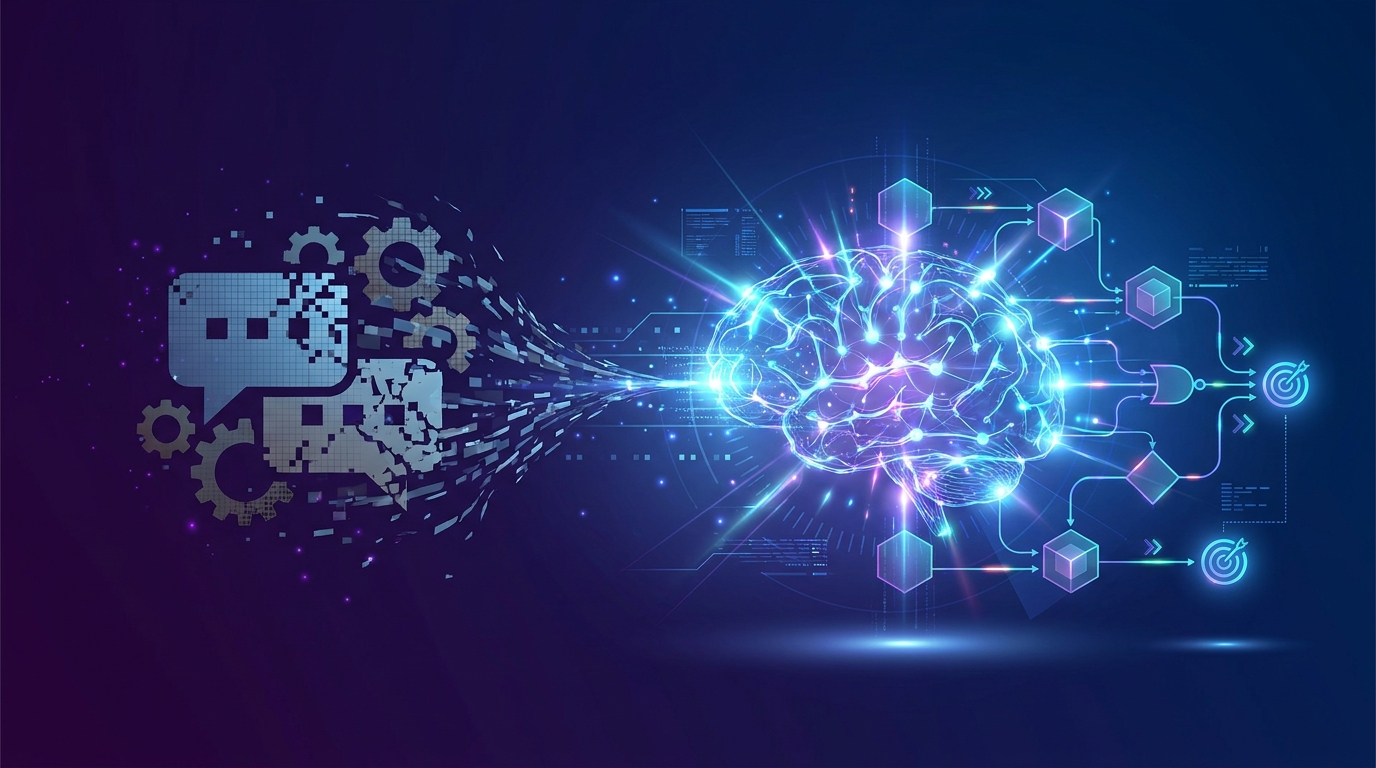
The Chatbot Era is Dead: How Automation Architects Delivers AI Agents That Actually Work in Production
Author: Agent Agency Team
Published date: September 09, 2026
Reading time: 7 minutes
Location: Cape Town, South Africa
Area Served: South Africa
Here is a brutal truth for anyone trying to scale AI right now: By the end of 2027, 40% of enterprise AI agent projects will be canceled.
Not because the large language models (LLMs) aren't smart enough. Not because the vision is wrong. They will fail because of cost blowouts, non-existent risk controls, and a complete lack of measurable ROI.
Right now, the market is flooded with "agent washing." Vendors are taking simple retrieval-augmented chatbots or rigid RPA scripts, slapping a new label on them, and selling them as autonomous agents. But you know a demo isn't production. A sandbox environment where a bot answers a few FAQ questions is miles away from a digital teammate that can reliably audit a spreadsheet, cross-reference a CRM, and execute a multi-step billing sequence without hallucinating.
The gap between companies running experimental playthings and those deploying real agentic workflows is widening fast.
We don't build toys. At Automation Architects, we build production-grade AI agents that actually work in the real world. We launched AgentAgency.ai to give teams the AI workforce management, strict control planes, and trajectory evaluation needed to cross the chasm from proof-of-concept to reliable digital labor.
Here is exactly how we deliver agents that survive production.
The PoC Illusion and the Error Amplification Trap
Why do agents look flawless on YouTube but completely break in your tech stack? It comes down to basic math.
Demo agents usually showcase three to five-step tool chains. If an LLM has a 95% accuracy rate per step, a simple sequence looks like magic. But enterprise workflows aren't simple. If you deploy an autonomous agent on a 10-step sequence, that 95% accuracy compounds exponentially: $(0.95)^{10} = 59.8%$.
In a business context, a 60% success rate means you just built an automated liability.
According to the LangChain State of Agent Engineering Report (2026), 32% of technical leaders cite quality and reliability as the number one blocker to shipping agents. Teams monitor logs, but they don't systemically evaluate execution paths before shipping.
"Why do so many AI agents fail when moving from sandbox to production? Continuous evaluation and observability act as the essential scaffolding for enterprise automation," notes Jason Lopatecki, CEO of Arize AI. "Infinite real-world inputs require continuous production monitoring rather than traditional pre-deployment testing."
We solve this through trajectory evaluation. When an Automation Architects agent takes a multi-step path, we don't just look at the final output. We test and evaluate every step, persist the state, and build automatic fallback pathways. If a workflow fails on step four, the agent doesn't start over or guess blindly. It rolls back the state and executes targeted recovery.
The Automation Architects Blueprint: Control Planes Over Chaos
The biggest architectural mistake you can make is giving an LLM direct execution authority. LLMs are incredible reasoning engines, but they are non-deterministic. Enterprise databases demand absolute determinism.
We advocate for separating Reasoning Authority from Execution Authority. Enter the Agent Control Plane.
Here is how our architecture works in production:
- The Request: The user (or system trigger) submits a complex task.
- Reasoning: The LLM agent formulates a multi-step execution plan and proposes an action vector.
- The Control Plane: Before anything happens, our deterministic control plane steps in. It verifies schema constraints, checks policy parameters, evaluates idempotency, and flags human-in-the-loop escalation gates if confidence is low.
- Execution: Only after deterministic clearance does the system hit your enterprise APIs or databases.
As the Anthropic Engineering team puts it: "Constraints aren't a weakness in agent design—they are the core feature. Workflows orchestrate LLMs through predefined code paths; agents dynamically direct their own processes. In production, narrow agents with deep structured context beat broad, unconstrained agents every time."
Ending Integration Hell with Model Context Protocol (MCP)
Read-only knowledge agents plateau at a 30–35% resolution rate. If your agent can't take action, it's just a search engine with a chat interface. But agents deeply integrated into transactional systems (CRM, ERP, billing) achieve 70–80% resolution.
Historically, connecting AI to your SaaS stack meant writing brittle, custom connectors that broke every time an API updated.
In 2026, we standardized on the Model Context Protocol (MCP). MCP is the universal standard for securely exposing databases like Snowflake and SaaS tools like Salesforce to AI agents. It means we deploy agents faster, scale them infinitely, and maintain strict data sovereignty without rewriting interface code.
Currently, 73% of companies plan to integrate agents with MCP servers within 12 months. If your agency partner isn't building on MCP, you are paying for technical debt.
Beating the "Agentic Scaling Wall" with Task Budgets
Unbounded autonomous agents are a fast track to a massive cloud bill. Without architectural constraints, agents can enter infinite loops, burning through reasoning tokens and exploding your OpenAI or Anthropic costs.
As a recognized partner in Anthropic’s Claude Partner Network, Automation Architects leverages multi-model orchestration. We deploy Task Budgets. We explicitly cap reasoning loops (e.g., maximum 5 tool retries or a $0.50 hard cap per task).
Through AgentAgency.ai, we guarantee model-agnostic deployment. You don't get locked into one vendor. We route low-complexity sorting actions to lighter, cheaper models, reserving heavy multi-step planning for powerhouse models like Claude Opus 4.7. You get the intelligence of a massive model at the blended cost of a lightweight one.
The ROI of Digital Labor
The narrative has shifted from conversational AI to Digital Labor. 75% of business executives now believe AI agents will reshape the workplace more fundamentally than the internet did.
But transformation doesn't happen in the shadows.
"We are encouraging companies not to sanction employees who are using AI tools that management hasn't officially vetted yet," says Lasse Vinther, Managing Director of Automation Architects. "Right now, everyone is a little bit scared—they aren't sure if they are allowed to use AI, so they do it in the shadows. The solution is clear adoption roadmaps, continuous policy development, and structured governance rather than blanket prohibition."
That is exactly what we provide. We replace shadow AI with managed, observable, and compliant digital teammates.
The companies that win this decade won't be the ones with the most chatbots. They will be the ones that successfully engineered AI agents to operate at scale, securely, and autonomously in their production environments.
FAQ
1. What is the difference between a chatbot and a true AI agent? A chatbot answers questions from a static knowledge base. A true AI agent evaluates a goal, formulates a multi-step execution plan, uses tools via APIs to take action, inspects intermediate outputs, and self-corrects on errors until the objective is complete.
2. Why do most AI agents fail in production? They fail due to error amplification. A 95% accuracy rate per step drops to a ~60% total success rate over a 10-step process. Without trajectory evaluation and state management to correct errors mid-task, the agent will ultimately fail or hallucinate.
3. What is an Agent Control Plane? It is a deterministic gateway that sits between the LLM's reasoning engine and your enterprise databases. It validates schemas, enforces company policies, and ensures an agent’s proposed actions are safe and accurate before allowing execution.
4. How does Automation Architects prevent unpredictable LLM costs? We enforce Task Budgets. This restricts the number of retries and caps the monetary spend per task to prevent infinite reasoning loops. We also use multi-model orchestration, dynamically assigning cheaper models to simple tasks and advanced models to complex reasoning.
5. How do agents interact with our existing enterprise software? We build heavily on the Model Context Protocol (MCP). This open standard allows us to securely expose your existing SaaS tools (Zendesk, Salesforce) and databases (Snowflake, AWS) to AI agents without building brittle, custom API integrations.
6. Does your architecture support data sovereignty and compliance? Yes. Our systems are built to run within strict regional boundaries, supporting POPIA in South Africa, GDPR/EU AI Act in Europe, and HIPAA/NIST in the US. Every action is logged in an automated decision audit trail.
Bottom Line
AI agents are shipping in production right now, and the ROI gap between adopters and bystanders is growing exponentially. But scaling beyond a proof-of-concept requires strict data engineering, deterministic control planes, and robust integration protocols. You can't just throw LLMs at a workflow and hope for the best. You need an architecture designed for digital labor.
References
- LangChain (2026). State of Agent Engineering Report (Survey of 1,300+ technical leaders).
- Gartner Research (2025/2026). Enterprise AI Agent Adoption & Forecasts.
- PwC (2026). AI in the Workplace Study.
- Merge.dev (2026). State of Agentic Integrations Report.
- Google Cloud Tech / Arize AI. Architecture for Running Agents in Production (Jason Lopatecki).
- Anthropic Engineering Team. Building Effective AI Agents Architecture Guide.
- TravelNews. Shadow AI and Enterprise Adoption (Interview with Lasse Vinther).
Ready to Ship Agents That Work?
Stop wasting engineering cycles on brittle PoCs that fail the moment real users touch them. Whether you need custom agentic workflows designed for your enterprise or a fully managed AI workforce platform, we have the architecture to make it happen.
Visit AutomationArchitects.ai for enterprise data and agentic engineering, or scale your digital teammates today at AgentAgency.ai.
About AgentAgency.ai
AgentAgency.ai is a managed AI workforce platform built by the team at Automation Architects. Based in Cape Town and serving clients across South Africa and the globe, we specialize in bridging the gap between advanced data engineering and reliable AI automation. We don't just prompt—we architect digital labor that drives real business outcomes.