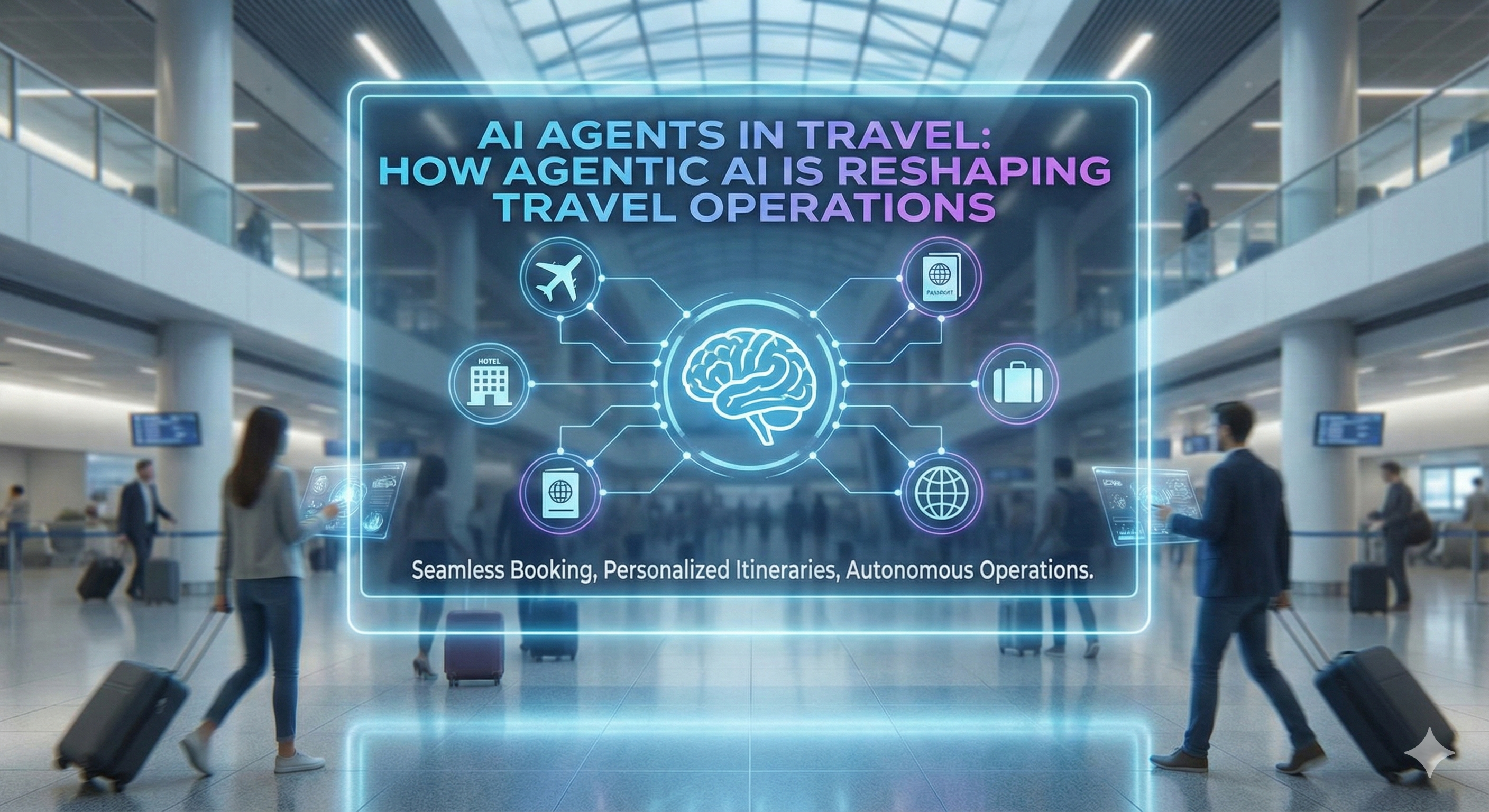
Yes, dreaming up your next getaway can be exhilarating. But booking it? Often less so. For many customers, the thrill of travel risks getting lost in logistics—a problem AI agents and agentic AI technology are now solving at scale.
On this episode of The AgentAgency Executive Briefing, Lasse Vinther, Founder & CEO of AgentAgency.ai, discusses how autonomous travel agents are reshaping travel operations and transforming the travel industry in 2025. In fact, we explore new data on AI adoption in travel companies, including how AI agents are designing end-to-end itineraries, autonomously rebooking disrupted flights, and fundamentally changing profit margins for travel management companies.
The AgentAgency Executive Briefing features insights from industry leaders and operational data on enterprise AI solutions and travel automation. (The following transcript has been edited for clarity and length.)
Travel in the Age of Automation
How are AI agents transforming travel booking workflows and eliminating logistics friction?
Lasse Vinther: The typical customer likes travel research but hates converting that into a specific itinerary. That's where the friction lives—and where margins erode. Agentic AI fundamentally restructures this workflow, eliminating friction entirely rather than managing it. This is how autonomous travel agents and travel automation are revolutionizing travel operations.
What's the current state of agentic AI adoption across travel companies in 2025?
Lasse Vinther: We're seeing a split market. "Experimenters" play with chatbots. "Operators" deploy real infrastructure. We've deployed over 500 active autonomous agents across our client base, particularly in complex markets like South Africa where payment friction and currency volatility demand enterprise AI solutions.
Why do travel companies struggle with AI ROI, and how can agents deliver measurable P&L impact?
Lasse Vinther: The "AI Paradox"—companies invest but don't see P&L impact—results from poor implementation, not poor technology. When applied correctly to travel workflow automation, the impact is immediate. We've tracked a reduction in complex quoting time from 3.2 hours to 0.8 hours. That's 4x capacity increase. Real ROI. Real numbers.
Humans and Agents at Work—Together
How can AI agents automate travel consultant workflows and liberate workers from manual data entry?
Lasse Vinther: It liberates consultants. Currently, your best talent spends hours as a "human API"—copy-pasting data between GDS screens. Agentic AI automates repricing, availability checks, PNR monitoring, and flight rebooking. Humans focus on high-value negotiation and relationships. That's where the magic happens.
What human-only skills remain vital in an AI-driven travel experience?
Lasse Vinther: Empathy and exception handling. Travel is emotional. When a family is stranded, they want a human who understands the gravity. The agent handles logic; the human handles magic—calming the client and making the decision.
Which middle office operations can be delegated to AI agents?
Lasse Vinther: We're delegating the "Middle Office"—complex itinerary construction, price monitoring, schedule management, and autonomous flight rebooking. Our "Watchdog Agents" proactively monitor bookings for disruptions and propose solutions before clients call. This alone drove 73% reduction in client churn. It transforms agencies from reactive to proactive travel managers through AI-powered travel management systems.
Making Headway on the Agentic Journey
What's the optimal deployment strategy: customer-facing chatbots vs. internal travel workflow automation?
Lasse Vinther: Don't start with customer-facing chatbots. High risk, low value. Start with Workflow Automation. Where do consultants bleed time? Quoting? Reconciliation? Deploy a specialized agent there. Prove ROI with cost-per-quote metrics in a safe sandbox. This is how travel automation generates measurable results without brand risk.
How should travel organizations structure agent factories at scale?
Lasse Vinther: You need a structured "Agent Factory" where AI is segregated into specific roles—Researcher, Calculator, Executor. Staff manages a virtual AI workforce, not just software. This requires a mindset shift from "doing the work" to "managing the agents who do the work." This is enterprise AI workforce management for travel companies.
How quickly do efficiency gains offset implementation costs?
Lasse Vinther: When you cut a 3-hour task to 45 minutes, you manufacture time. That reclaimed capacity pays for the learning curve immediately. Agencies handle peak volumes without panic hiring. That's ROI in travel automation.
Managing Risks and Building Trust
How can travel companies introduce AI to reluctant customers?
Lasse Vinther: Transparency matters, but utility matters more. Customers don't mind autonomous travel agents if they work. If an AI-powered rebooking agent rebooks a cancelled flight before the customer reaches the airport, they don't care if it's a bot—they care the problem is solved. That's how travel automation builds loyalty.
What governance frameworks does travel automation require?
Lasse Vinther: "Generalist" AI models fail in travel. You need Segregated Agentic Architecture. By isolating agents—one handles content, another handles GDS—we implement Individual API Key Tracking. We know exactly which agent took which action and the cost. This audit trail and financial governance is what C-Level executives require. Generic LLMs can't offer this. This is why vertical specialization and enterprise AI solutions outperform generic travel chatbots.
How does vertical specialization mitigate agent-related risks?
Lasse Vinther: Our autonomous travel agents are built on travel industry logic, refined in complex South African markets with payment friction and currency volatility. By encoding strict business rules into agents, we reduce human error. The system won't forget visa requirements or fare rules. This is how vertical AI agents provide superior risk management compared to horizontal generalist models.
What Agentic AI Means for Brands and Competition
How can travel brands maintain relevance in an AI-mediated world?
Lasse Vinther: Brand value shifts to service assurance. If your agency uses AI to deliver seamless, disruption-free experiences, that's your signature. The AI is the engine; the brand is the car. Customers remain loyal to travel companies that make their lives easier, not just cut costs. This is competitive advantage in the era of travel automation and agentic AI.
How can smaller travel operators compete with OTAs?
Lasse Vinther: Smaller players have agility advantage. They deploy "Agent-as-a-Service" platforms faster than legacy giants overhaul mainframes. They launch a quoting agent tomorrow and compete with global OTAs while maintaining boutique service. This democratization of enterprise AI solutions and travel automation technology levels the playing field for travel agencies and travel consultants.
The Future of Autonomous Travel
What's the competitive advantage of vertical AI agents vs. horizontal generalists?
Lasse Vinther: Vertical specialists win because they possess deep industry context. You'll see hybrid models: general interfaces that hand off complex tasks to specialized vertical agents executing actual booking and logistics. This is why travel companies choosing vertical specialization and enterprise AI solutions outperform those relying on generic AI travel chatbots and ChatGPT-style solutions.
What does the future of autonomous travel look like?
Lasse Vinther: We're moving from "Search" to "Action." The friction of booking, changing, and paying evaporates into the background, managed by silent, efficient autonomous travel agents. We're building the autonomous infrastructure of the travel industry. This is the future of travel automation and the evolution of AI-powered travel management systems in the age of agentic AI.
Ready to Transform Your Travel Operations?
AgentAgency is trusted by travel leaders including TLC Vacations, Flight Centre, and Glyde. Start with workflow automation and scale your AI workforce from startup to enterprise.
Get Started with AgentAgency or Book a Demo to see how travel companies are achieving 4x efficiency gains and 73% reduction in client churn.